Nature abhors a vacuum (Aristotle), and we all find ways to fill emptiness in our lives and in our souls. It can become a constant battle, especially for those living with hoarders.
When it became clear that Mother could not live alone (convincing her of this is another subject). It fell to me to clear out her living space. I’m still dumbstruck at what I found; pure garbage interspersed with important documents, pictures, collectibles valuable to family members.
This was not a new phenomenon, Mother couldn’t stand to throw out anything for as long as I can remember. Partly due to her creativity, she could imagine a use for just about anything, including saving dryer lint to use for packing material. I also attributed it to her living through the great depression. However, through a week-end seminar, I found out the deep psychological underpinnings of those who hoard (info here).
A Little About Hoarding
For those of you having no experience with hoarding, it is one of the most difficult psychological disorders to treat. I’ll give you a brief overview.
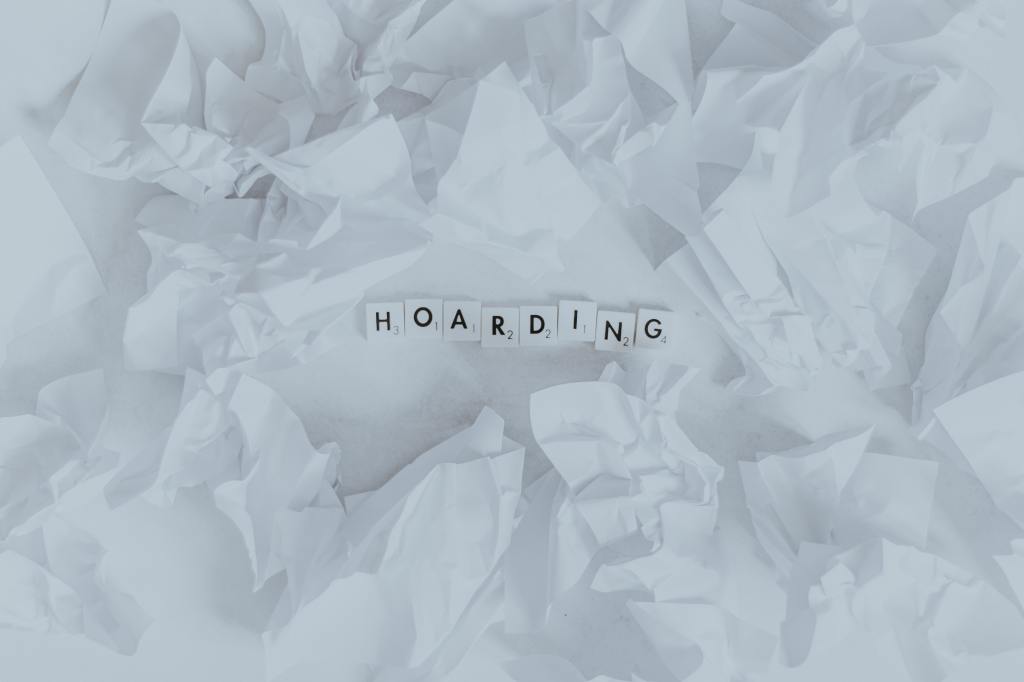
“Hoarding disorder” is a persistent, ongoing difficulty throwing away or parting with possessions because you believe that you need to save them. This includes:
– Inability to get rid of possessions (selling, recycling, giving away)
– Experiencing extreme stress when attempting to throw out items
– Anxiety about needing items in the future
– Distrust of other people touching possessions
– Uncertainty about where to put things
– Living in unusable spaces due to clutter (clutter makes it dangerous to move easily throughout home spaces)
– Piles of things that risk tipping over (newspapers, magazines, mail)
Most importantly, hoarding disorder can cause problems in relationships, social and work activities, and other important areas of functioning. It did indeed become an area of contention within our family dynamics.
De-Hoarding Experiences
I’m pretty well organized and like things orderly, although not obsessively. It is important for you to know that this can happen with people who have lived through abusive situations. They need to be hyper-alert and prepared to protect themselves and other family members (this could be another blog).
I knew sorting through Mother’s hoarding would be a big task, but I did not realize how monumental it would be. One spare bedroom in which you could barely open the door, was piled floor to ceiling. The other spare bedroom was three-quarters full. The main bedroom was one-half crammed. The living room area was also one-half usable. The kitchen three-quarters. Then there was the shed.
You may be interested in some of the things I found, necessitating multiple truckloads to take to the dump, multiple van loads to recycling shops, multiple trips to the post office to mail wanted memorabilia to family members.
Among the most notable items I found: toothpaste caps, empty containers (deodorant & laundry & food & boxes of all sizes), dryer lint, 40 years of old calendars & church bulletins & newspaper clippings, 30 pairs of scissors, innumerable dried up pens and markers, 50 old eye glasses, broken items: 5 coffee pots & 4 crockpots & etc, 300 picture frames, countless very old shoes and clothing, stale candy (mother would throw candy over the junk pile, hoping to motivate herself to start sorting).
[If you are interested, you can find details of my sorting and moving out techniques in my blog on my other site.]
Here is a tip: Keep the person away, even when they try to invade your boundaries (made more difficult when you are dealing with a clinically diagnosed person and other family members who don’t understand). As you may guess, this became a real issue. Not only were my sisters too emotionally attached to sort even the basic throw-away stuff, Mother continued the “divide and conquer” strategy, true to her manipulations and need for ultimate control.
After moving Mother to a senior facility, hoarding became a constant battle. I discovered the truth of, “Once a hoarder, always a hoarder.” Peace came when my brother pointed out, “Let it be. When it comes time to clean out her place, it’ll be easy to get started with the total junk.”
Unfortunately, I did not pace myself, nor deal with anxiety, nor grieve in a timely manner. I did not keep up my exercise and meditation routine, and I suffered the consequences. I say to you, “Be kind to yourself and find a support system.”
 5 golden years
Leave a comment